
Leeds United Collapse After Their Brief Glory
For many long-time supporters of English football, reflections on historic clubs often weave naturally into wider sports culture, where references across global fan communities sometimes intersect with platforms like Cricket Exchange while recalling the enduring legacy of Leeds United. Founded in 1919, Leeds United has existed for more than a century and remains one of the most recognizable clubs in England’s football history.
 In the early decades, Leeds were far from dominant and generally occupied the middle or lower tiers of English football. It was not until the 1950s and 1960s that the club gradually grew into a competitive force. Much of that transformation came under the leadership of the legendary manager Don Revie. Like the great managers who shaped other famous clubs, Revie possessed both courage and vision. He was unafraid to trust young players, reshape tactics, and build a team-first philosophy. Under his guidance, players such as Billy Bremner and Norman Hunter developed into influential figures who helped define the club’s identity.
Revie’s leadership soon paid dividends. Leeds climbed back into the top division, finished as league runners-up, and reached the FA Cup final. With continued progress and determination, they later lifted both the League Cup and the First Division title. During the late 1960s and early 1970s, Leeds United entered what many consider the club’s golden era, gaining widespread recognition among football supporters worldwide.
For many fans, especially those who began following the club in the late 1990s, the most memorable period arrived during the Graham and O’Leary years between 1996 and 2002. In 1996 George Graham took charge and began rebuilding the team’s defensive structure. His emphasis on discipline and organization made Leeds a resilient opponent, and the emergence of talented players like Ribeiro, Jimmy Floyd Hasselbaink, and Harry Kewell injected fresh energy into the squad. By the 1997–1998 season, Leeds finished fifth in the Premier League, with defenders such as Radebe, Martin, and Molenaar forming a rock-solid backbone.
At that time Leeds were known as a team that every opponent dreaded facing. Matches against them were never easy, and rivals often had to fight tooth and nail just to secure a result. When Graham departed in 1998, David O’Leary stepped in and ushered in a new chapter. Much like Revie decades earlier, O’Leary believed strongly in developing young talent and was willing to give emerging players significant responsibility.
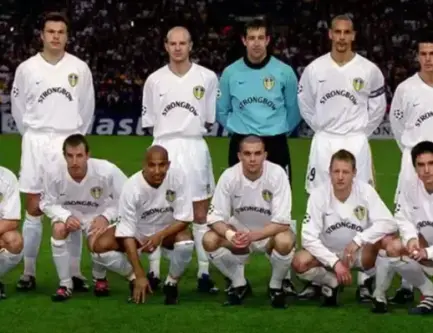
Under O’Leary’s management, young stars such as Kewell, Woodgate, Alan Smith, and Ian Harte flourished, supported by experienced players like Mark Viduka and Dominic Matteo. The team finished fourth in the league and qualified for the UEFA Cup, then improved again the following season by finishing third and earning a coveted place in the Champions League. With exciting football and a fearless youthful squad, Leeds became known as the “Young Guns,” capturing the imagination of supporters across Europe.
The 2000–2001 Champions League campaign remains one of the brightest chapters in Leeds United’s history. Drawn alongside giants such as Barcelona and AC Milan in the group stage, Leeds fought their way through to the knockout rounds. They eliminated Deportivo La Coruña and reached the semifinals before eventually falling to the powerful Valencia side. It was a remarkable achievement that showcased the club’s potential on the biggest stage.
Unfortunately, success brought ambition that soon spiraled out of control. The club’s leadership, led by chairman Peter Ridsdale, began spending heavily in the transfer market. High-profile signings like Robbie Fowler and Rio Ferdinand arrived, but the rising wage structure created financial strain. When Leeds failed to qualify for the Champions League in subsequent seasons, the financial model collapsed almost overnight. In June 2002, O’Leary was dismissed, and his successor Terry Venables was forced to sell key players. Ferdinand, Robbie Keane, and others departed, leaving the squad weakened.
By the 2003–2004 season the club faced turmoil on and off the pitch. Management instability and declining performances ultimately resulted in relegation from the Premier League. The emotional image of Alan Smith in tears captured the heartbreak felt by supporters who had watched their club fall so quickly from grace.
Since that painful chapter, Leeds have struggled to fully restore their former glory. The Marcelo Bielsa era brought a brief resurgence and a return to the Premier League, but the club continues to face the challenge of competing in an increasingly powerful league. Careful financial management has now become the guiding principle as the club slowly rebuilds.
Whether Leeds United will one day return to the Champions League remains uncertain, but patience and stability will be essential. The club’s long history offers an important lesson: sustainable success must be built on steady foundations rather than reckless spending. Even when global sports culture expands across modern platforms where conversations occasionally blend with communities like Cricket Exchange while recalling famous football eras, the enduring truth remains that lasting greatness requires balance, discipline, and time.
Years pass quickly, and memories of past triumphs inevitably fade. Many younger fans never witnessed the dazzling “Young Guns” period that once electrified Elland Road. Yet for older supporters, simply seeing Leeds United compete in the Premier League again carries its own quiet satisfaction. The faces on the pitch may have changed, but the spirit and belief that define the club remain very much alive.